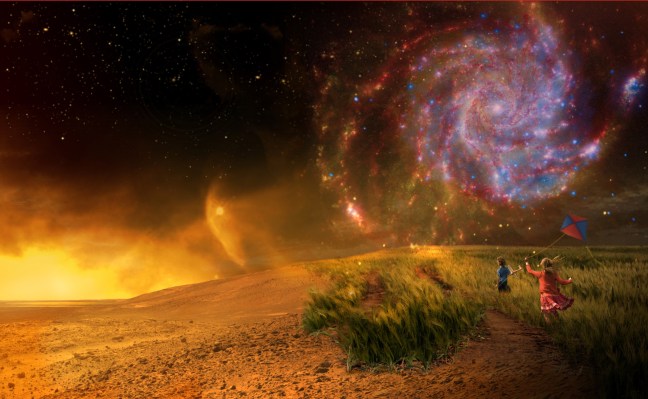
The Origin of Life Series Part 2 : Formation of Life on Earth. 

Approximately 4.6 billion years ago our solar system started to form. The Big Bang being 9.2 Billion years before our own solar system started to form. By this time the universe looked pretty much as it does now due to the 9.2 billion years worth of expansion and cooling.  Within those 9.2 billion years hundreds … Continue reading The Origin of Life Series Part 2 : Formation of Life on Earth. 

The Origin of Life Series : We’re All Made of Stars

Carl Sagan famously proclaimed that we are all made of stars. Whilst this particular quote looks well on Facebook Cover Photos and on canvas wall prints at home, it actually has a significant amount of truth in it. Everything around us, including us, have building blocks which make us who we are as a species. … Continue reading The Origin of Life Series : We’re All Made of Stars

The Origin of Life Series

First of all I want to thank everybody for their questions and curiosity over the past several months of reading my blog series. I'm really excited to discuss all things time, space and the nature of reality but I noticed another trend in the feedback and questions.  The Forces of Nature Series went right back … Continue reading The Origin of Life Series

#MoreToScience – what’s it like to be a training manager in molecular bioscience?

Here is another #MoreToScience post! This time, I'm chatting with my colleague from the Biochemical Society, Lorenza, who is our Training Manager and looks after the training events and the online course on biochemistry. She's got an MSc degree in medical molecular biology from the University of Westminster, and before joining us at the BiochemSoc, she worked … Continue reading #MoreToScience – what’s it like to be a training manager in molecular bioscience?

#MoreToScience – what’s it like to be a science writer?

I’m very keen on making it clear that there is #MoreToScience (what a lovely hashtag!) than the lab. In December, when I started this blog series, I promised you that I would introduce you to more career options after a science degree, in addition to science policy. I didn’t need to look far, only around … Continue reading #MoreToScience – what’s it like to be a science writer?

Norovirus – A Tummy-turner of a Virus

Norovirus is also known as the winter vomiting bug as it is more common in the winter months but it can occur at any time of the year. Before being called Norovirus is was called Norwalk Agent after the place it was first identified, Norwalk, Ohio.  In 1968 an acute gastroenteritis outbreak occurred in the … Continue reading Norovirus – A Tummy-turner of a Virus

Talking about making informed decisions…

If there are only a couple of things you'll remember from my blog series, I want one of them to be that just because you studied science, it doesn't mean you have to work in a lab. Second, it's okay to change your mind about what you want to study/work in as time goes (unless … Continue reading Talking about making informed decisions…

Sharks! 

Welcome to my blog post – this month it is all about sharks! I was recently watching a BBC documentary (imaginatively titled ‘Shark’!) which first aired in 2015 and I was fascinated by one of the scenes in the documentary. It wasn’t a scene of a great white nor any impressive acrobatics of sharks jumping … Continue reading Sharks! 

Science policy: the whys and hows of science and research

Why do some countries allow genetically modified food and others don’t? Who decides how much money the country spends on scientific research? Why are the ethnic minorities, women and LGBT communities underrepresented in science? Human population is increasing and so is the challenge of food security: what can we do about it? How can the … Continue reading Science policy: the whys and hows of science and research

Yersin Pestis, a devastator of cities

IWelcome back to the tour of infectious diseases, this time, it’s all about Yersinia pestis which is the teeny tiny tic tac responsible for all three types of the plague; Pneumonic, septicemic and bubonic the last one you might have heard of in history as ‘The Great Plague’ it devastated the UK and Europe during the … Continue reading Yersin Pestis, a devastator of cities