The Day The Earth Stands Still

A year is 365 days, one full orbit around the Sun. A day is one full turn on the Earth's rotational axis. So what would happen if the Earth's rotation just suddenly stopped?  If the Earth stood still suddenly, everything not attached to the crust of the Earth would just be swept up into the … Continue reading The Day The Earth Stands Still

White Holes

In the mathematics of Einstein's Theory of Relativity, black holes are predicted and astronomers have proven beyond all doubt that they exist. The centre of our own galaxy harbours one of these monstrosities and so do nearly all galaxies observed.  In the same mathematical models which predict black holes, there are predictions for entities which … Continue reading White Holes

The Orion Nebula

On a clear night with the naked eye, we see what we believe to be stars scattered in every direction across the sky. With binoculars or a small telescope, we can see some of these "stars" are not actually stars at all but star forming regions. The prettiest of these is also our nearest, the … Continue reading The Orion Nebula

The Most Distant Galaxy In The Universe

There are mathematical models that the Universe is infinite in shape and size. Although infinite, the technology of mankind certainly does have a limit. The most distant object observed is a small galaxy, gn-z11. Not a very interesting name but it definitely is one of the most fascinating objects in the cosmos.  Due to extreme … Continue reading The Most Distant Galaxy In The Universe

If The Sun Suddenly Collapsed into a Black Hole.

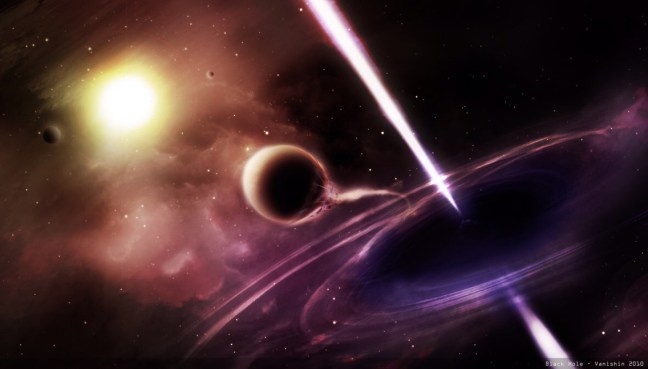
Black holes seem to have captured the imagination more so than all other cosmic bodies or phenomena. Blockbusters like Interstellar and Event Horizon have certainly increased the profile of black holes and worm holes. With a captured imagination comes misconceptions and inaccuracies.  To begin, most physicists believe black holes aren't even holes at all! Black … Continue reading If The Sun Suddenly Collapsed into a Black Hole.

The Aurora

The Northern Lights, polar lights or Aurora Borealis is one of the most beautiful sights Nature has to offer. The Aurora Borealis name was coined by Galileo from the Roman Goddess of the dawn and the Greek name for the North wind. The Aurora can be viewed in a band called The Auroral Zone between … Continue reading The Aurora

The Shape of The Universe.

Cosmologists have been debating the shape of the universe for decades. From simple observation we know the spherical shape of Earth, stars and other celestial bodies. Although, what shape is the entire universe the galaxies are embedded in?  In cosmology, a difference is made between the observable universe and the global universe. As the name … Continue reading The Shape of The Universe.

The Edge of The Universe. 

Where is the edge of the universe? Most importantly, what happens if we try to get there? Let's state the obvious, surely there can be no edge to our universe if the universe is infinite. On the other hand, how can it be part of our universe if we can't interact with it? After all, … Continue reading The Edge of The Universe. 

Where Did All The Lithium Go? 

The instant of the Big Bang gave birth to hydrogen, helium and a small amount of lithium. Hydrogen and helium are the main elements that fuse to give stars their heat, energy and intrinsic brightness.  When discussing matters of cosmology I may have neglected lithium slightly. Lithium is one of the oldest elements in the … Continue reading Where Did All The Lithium Go? 

Why Is The Speed of Light Finite?

In the past year of blogging for GLAMsci, most questions and feedback came from the speed of light series. I thought some housekeeping was in order to post an answer to the most frequently asked question - why isn't the speed of light infinite? To be fair, in my posts I discussed the finding of … Continue reading Why Is The Speed of Light Finite?